This is the record of all the talks held in 2025
November’s talk: Working with the military: presenters under stress by Alex Leger
Alex gave us a very interesting talk about his film work with the Blue Peter TV program. He started under the famed producer, Biddy Baxter and continued into the 2000s. This meant he worked with many of the young presenters who led the program at different times. One feature of the program was showing the presenters doing exciting and challenging activities. For example, formation free-fall parachuting or learning to survive at -40 C in Norway. Many of these he did in collaboration with the armed forces as their safety record was second to none. All of the activities were difficult for the
presenters and Alex was impressed with their determination to finish the tasks even when they were at the limit of their abilities. He spoke of Gethin Jones who completed a 30 mile ‘yomp’ across Dartmoor even though he had to pause for a while to recover, and of Connie Huck who visited Angola to defuse land mines. Many of the challenges required physical training before attempting them and were pretty scary.
Alex’s filming showed all the stages. Showing the presenters overcoming their fears was an important part of the story. If all this sounds serious, Alex had some light-hearted stories. His tale of the run across the Exe estuary had us all laughing. It was a most enjoyable and uplifting talk.
Octobers talk: James Taylor – ‘Horatio Nelson: a complex character’
We all know about Nelson as a naval hero but there’s much more to him than the battle of Trafalgar. James gave us a fascinating talk illustrated with the many portraits of him. Nelson was one of eleven children of a Norfolk rector. His education was very basic, and he was a small, slight child. It did not bode well for his future. However, his uncle, Captain Maurice
Suckling, despite strong reservations about Nelson’s suitability, took Nelson on a polar voyage and so started his naval career.
Despite his insignificant appearance and early receding hair, Nelson was something of a ladies’ man. He often fell in love, sometimes with married women. He met his wife, Fanny, while serving in the Caribbean. At first, they were very happy. However, they remained childless. Fanny stayed at home in England, looking after Nelson’s aged father. Nelson spent much time aboard ship.
We all know that Nelson was a brave man, respected by his sailors and innovative in his battle tactics. But his life was far from simple. He lost the sight in one eye in a battle to capture Corsica and was relegated to diplomatic duties after this. He was able to return to active duty and in a failed attack on Tenerife, lost his right arm. After this he suffered a long period of depression as he felt he no longer had a purpose. However, as we all know, he went back to active service, having several important victories, before dying at the battle of Trafalgar.
The other famous fact about Nelson was his long-standing relationship with Emma Hamilton. Nelson abandoned his wife for Emma, setting up a home for her at Merton Place. Her life turned out tragically. After Nelson’s death, she was denied the money left to her in his will and died in poverty.
September’s Talk: Martin Pailthorpe – ‘Self Sufficiency and Conservation while filming WildLife in the Celtic Fringe’
Martin, who has spoken to us before, introduced himself as a former BBC producer & director of wildlife films. Several times in his career he had been involved in the production of films with the broadcaster & marine biologist Monty Halls. They filmed on Sandaig, (the setting for Gavin Maxwell’s ‘Ring of Bright Water’, where otters are becoming more common and formerly rare creatures such as the Sea Eagle and the golden eagle are seen more frequently), North Uist and Connemara, on the west of Ireland. The wildlife of each location was closely observed as were the conservation measures in place in each of them. Bottlenose dolphins are now seen off Connemara so frequently that it seems likely that it will soon be declared an SAC (a special area of conservation). Other cetaceans and sharks frequently seen off Connemara were minke, fin & humpback whales, orcas, blue sharks, whale sharks & basking sharks.
One character Martin introduced to us was Reuben, a pretty delinquent Labrador-type rescue dog adopted by Monty Halls, that took part in adventures in all three locations. Martin illustrated his talk with photos & video clips.
August Talk: Stephen Powles – ‘Otters: coming to the river near you’
Stephen practiced as a vet for many years; in later times he became a wildlife photographer and spent many happy hours filming the otters at the bottom of his garden. He had a particular favourite, nicknamed ‘Hammerscar’, because of the small scar on her nose.
Adult otters rage from about 7 – 12 Kg although a large male can reach up to 17 Kg. The males tend to be thickset and have damaged ears from fighting with other males. Females are more elegant, with thinner heads and intact ears. They have a very thick coat with as many as 50 000 hairs / square cm (compare this to us, we have about 100,000 hairs over our entire head). They have webbed feet and powerful tails. Their whiskers are very sensitive and help in their hunting.
Otters are found all over the UK, although from the 1950s, there was a sharp decline due to the presence of
pesticides in the food chain. Since the banning of DDT based chemicals, numbers have recovered well. However,
there are other threats such as traffic and pet dogs.
This was a well-attended meeting and Stephen showed us many lovely video clips, which sadly I can’t hope to
summarise
July’s Talk: Commodore Andrew Lambert ‘The Use of Aircraft in War and Personal Experiences’ Andrew’s talk was perhaps the scariest talk I’ve ever attended. He felt that in this time of uncertainty, being well equipped with weapons you are prepared to use was the best way to prevent others attacking. His experience in the Air Force also led him to believe that Air Power was versatile and effective in this preventative role. We are perhaps rather more familiar with the way aircraft were used in WWII. However, modern aircraft are very different. Andrew gave us a history of how aircraft have been used in warfare. From the use of planes in reconnaissance in WWI to the recent precision bombing of nuclear sites in Iran. He also looked to the future, where drones will be, and indeed are being used as cheap and very precise weapons.
Junes Talk.Prof. Peter Edwards – ‘The Life of Leonardo De Vinci and Selected Art’.
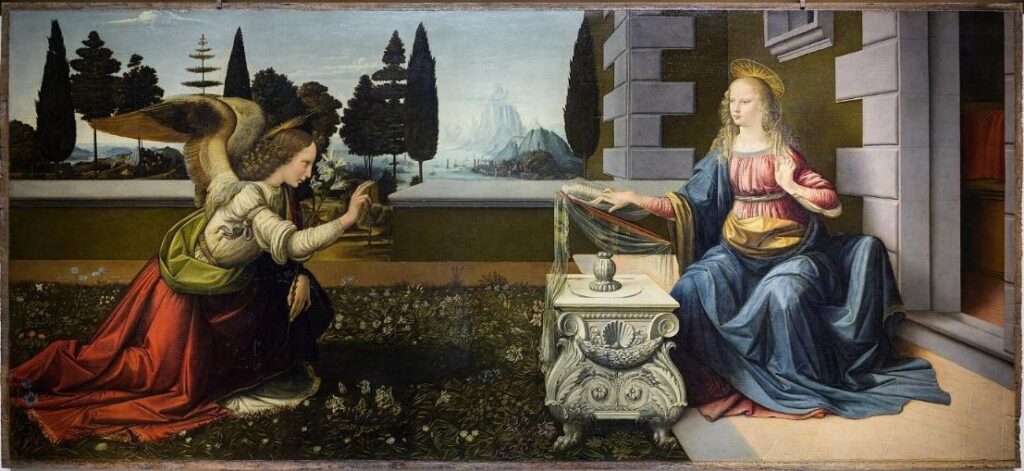
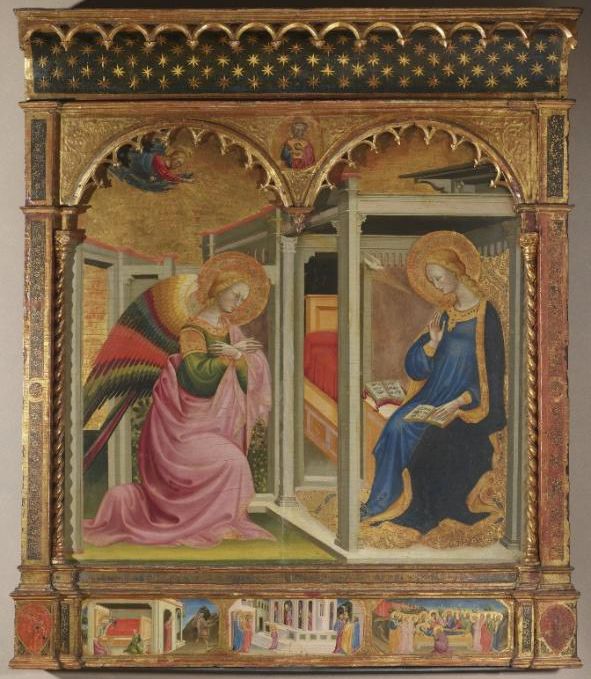
Peter told us that Leonardo Da Vinci (1452-1519) lived during the period of the High Renaissance. This was a time when art was becoming more realistic and also moving away from religious themes. Leonardo was at the forefront of this movement. He spent much of his working life in Florence under the sponsorship of the Medici family. To show you just how revolutionary he was, I’m using two images of the Annunciation to summarise Peter’s main points. One by Leonardo (above right) and one by an earlier Florentine artist, Stefano d'Antonio diVanni (above left).
In Leonardo’s picture, perspective is accurately portrayed. (Note that the distant mountains are shadowy.) His poses are more naturalistic. Look particularly at the faces. There are no hard lines round the features, they blend into one another, as they do in real life. He used his thumb or palm of his hand to blend away the hard edges (sfumato) and his fingerprint can often be seen on his painting. Leonardo completed very few paintings, and although undoubtedly a genius, was a difficult character. His impact on the Renaissance, however, is unquestionable.
May’s Talk: The British Honours System and Some Lesser-Known Awards by Ashley Jones
Ashley gave us an excellent and entertaining talk about the Honours System. We’ve all heard about the British Empire (BE) medals. Perhaps, like me, you were unsure of the sequence. The BEM is the lowest award and is given for short term, local service. Next is the MBE (M=member), then OBE (O=officer). CBE (C=commander) is given for high levels achievement in a particular field. KBE/DBE (K=knight, D=dame) is the highest level normally awarded. However, rarely, a GBE is awarded (G=Knight or Dame of the Grand Cross.) These awards make up 95% of the honours given out.
Some awards have only a limited membership. The Order of the Garter has only 24 members. There are only 24 members of the Order of Merit and 65 Companions of Honour. Both are awarded for sustained excellence in a field. If you have an OM, you get to have lunch with the monarch once a year. Another lesser-known award is the Order of St Michael and St George. These are awarded to people who work for the UK abroad. Often those who work for the secret services are given one of these. James Bond was a Commander of the Order of St Michael and St George! And in real life, Sean Connery was given the same
award.
If you know of someone who you think deserves an award, it’s easy to nominate them. There is an online form to fill in (https://www.gov.uk/honours), and you will need letters of reference. The nomination will go through a series of committees and about 50% of nominations are successful. To conclude, Ashley told us about the people who had many
awards. Perhaps it’s not surprising that David Attenborough is our most decorated citizen, with a total of 11 titles.
Aprils meeting: April’s Talk – Tourism in Devon and its Problems Sally Everton
Sally is the general manager of ‘Visit Devon’, an organization set up to encourage people to visit Devon. We, who live here, might moan about visitors who block up our roads, use our resources and occupy our homes. But in fact, tourism is a major industry for Devon, worth many millions of pounds a year and provides considerable employment. We need to encourage more people to visit!
Currently most visitors to Devon come from the ‘M4 corridor’ from London down to Bristol, probably because it’s relatively easy for them to get here. Sadly, these visitors are not big spenders! ‘Visit Devon’ would like to attract more foreign tourists who not only spend more but also visit outside the traditional holiday times. Sally told us about some of the ways her organisation hopes to attract more of these tourists. In the end, we need more investment in Devon to provide the resources.
Feb 2025 Meeting. Febs TalkFebruary’s Talk: Rome, Foundation to Empire’ by Brian Short
Brian took us through the mythology of the founding of Rome by Romulus and Remus. Surrounded on all sides by many other societies, Rome grew to be the largest and most successful empire in the world for many years. Partly this was because of the structure of their society but also because of the structure and training of their army. In 503 BCE, the Romans threw over their autocratic King and established a republic that lasted for the best part of 500 years.
The republic had a clear class structure. At the top were the Patricians (the toga wearers), who governed society. Beneath them were the Equites, a sort of educated middle class, then there were the Plebs and underneath all, the slaves. Boys of the
top two classes were educated for 10 years before doing compulsory military service. After this they were eligible to take on governing roles. These roles were determined by election every year and so a minimum degree of competence was required. The top role was Consul. There were two of these, so power wasn’t invested in one person. However, in times of crisis, a dictator could be elected to take decisions. There was also a Tribune, whose job was to represent the Plebs. The standing army was also unusual for the time. Rather than being a rag-tag of anyone who could fight, it was organized into clear divisions, led by the young, educated Equites and Patricians. The soldiers were well-trained and equipped. There were clear promotion prospects and rewards for good service. New methods of fighting such as the ‘Testudo’ – their famous impenetrable shield wall – were
developed. Loyalty to the Republic was paramount.
Eventually, this structure broke up. civil wars, internal power struggles and the rise of military leaders like Julius Ceasar led to conflicting loyalties. In 27 BCE, Octavian became the first Roman Emperor.
Jan 2025 Meeting.January’s talk: Jim Causley, singer & author, ‘Traditional Folk Songs of Devon’.
Jim told us that every region of Britain had its own tradition of folk music. Over time, the oral tradition of singing started to die out and much of the music was lost. In Devon, a local vicar and author, Sabine Baring-Gould made a prolific collection of folk music from around the country but particularly in Devon. For a time, he lived outside of Devon, but on the death of his father, he returned to live at the family manor at Lew Trenchard, near Okehampton. He was one of the founders of the movement to collect folk music during the late 19th century and inspired such people as Vaughn Williams. Baring-Gould obtained the songs
by advertising in local papers. Some people sent songs to him; others sang to him while he noted them down.
Jim sang five different local songs for us, telling us a bit about each one. The first song was called ‘Jack of all Trades.’ This linked towns and villages in Devon with particular jobs and was really a long list. The song was sent to BaringGould in 1908 by a lady living at Cowley Bridge. Baring-Gould sometimes sanitised the songs. Many folk songs are quite saucy.
As an example, Jim sang ‘The Mower’. This song was collected from Robert Hard, a stone breaker from South Brent. The song is about a mower and a young lady whose meadow had never been mown. You can imagine the rest! The songs could be very old. ‘Childe the Hunter’ probably dated back to 7th Century. This song was about the death of a young lord (childe) on Dartmoor
and collected by Baring-Gould from the Dartmoor poet Jonas Coaker of Postbridge.
Sabine Gould died in 1924 but not before he had published over 1200 works including fiction, collections of folk tale and folk songs. Today his best-known creation is ‘Onward Christian Soldiers’.
Jim finished his performance with a rousing rendition of ‘Widdicombe Fair’ with considerable audience participation.